Lecture by Sertaç Sehlikoğlu
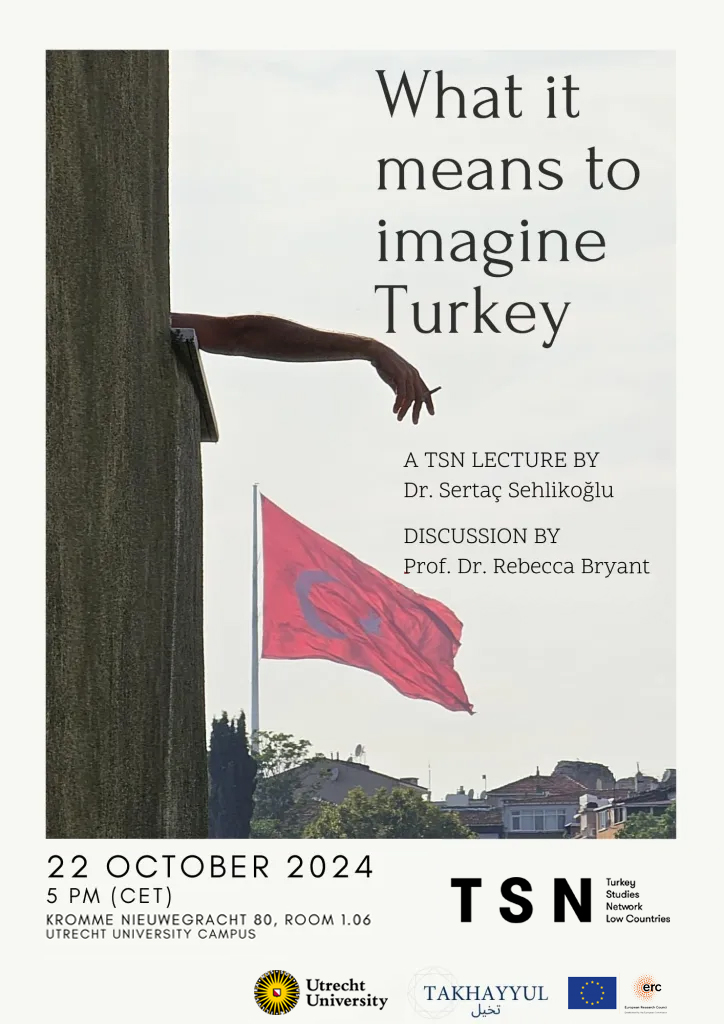
Tuesday 22 October 2024 | 17.00-18.30 CET (Lecture) | Utrecht University | Kromme Nieuwegracht 80, Utrecht | Room 1.06 | On-site only | Registration required
Join us for a stimulating lecture by Dr. Sertaç Sehlikoğlu (University College London).
Turkey has been forging a political imaginary and engineering a Turkish-ness, narrating a particular story of genetic and historical heritage. More recently, it has been investing in another, broader and more invasive imaginaries by evoking its imperial past that we refer to as neo-Ottomanism. Turkey’s political, financial, and cultural investments and even the popularity of its drama series in the Middle East, parts of Africa, and South Eastern Europe -known as the Balkans- are frequently referred to as “Soft Power”. This genre has landed itself in the rising scholarly interest in political imaginaries and populism.
After the completion of a multi-sited ethnographic and archival research on the complicated processes of political imaginaries and their interlinks between the cutaneous layers of the individual’s psyche and the integumentary layers of international interactions, this lecture addresses the basic tenets and the challenges of studying imaginaries in the context of Turkey. How were new imaginaries forged as political currency? How are Turkey’s own local struggles translated into narratives? How are these narratives received, circulated, defended, and dismissed by the public? Taking distance from IR approach and terms such as soft power, the lecture instead experiments with an alternative formulation of reality and imagination.
Prof. Rebecca Bryant (Utrecht University) will offer a commentary after the lecture. The event will be moderated by Dr. Hayal Akarsu (Utrecht University).
About the speakers
Dr. Sertaç Sehlikoğlu is an associate professor at the UCL’s Institute for Global Prosperity and the principal investigator of an ERC Starting Grant (2019). Formerly, she was the Abdullah Mubarak Al-Sabah Fellow at Pembroke College, Cambridge and the Gibbs Travelling Fellow at Newnham College, Cambridge. She is the author of three books, and the recipient of several awards and grants, including a BRISMES (British Institute of Islamic and Middle Eastern Studies) PhD Award, a Wadad Kadi Fellowship, a BIAA (British Institute at Ankara) Study Grant, and a William-Wyse PhD Award. Sehlikoglu is also the editor of the Journal of Middle East Women’s Studies’ Reviews Section and the associate editor of Contemporary Islam.
Prof. Rebecca Bryant is a cultural anthropologist at Utrecht University, specializing in ethnic conflict, displacement, borders, sovereignty, and post-conflict reconciliation, particularly in the eastern Mediterranean and Cyprus. Her most recent books are The Anthropology of the Future (co-authored with D. M. Knight, Cambridge University Press, 2019); Sovereignty Suspended: Building the So-Called State (co-authored with Mete Hatay, University of Pennsylvania Press, 2020); and The Everyday Lives of Sovereignty: Political Imagination Beyond the State (co-edited with Madeline Reeves, Cornell University Press, 2021). Her work has been supported by various organizations such as the European Research Council (ERC), Fulbright and the MacArthur Foundation.
Dr. Hayal Akarsu is an assistant Professor at the Cultural Anthropology department at Utrecht University. Previously, she was a Junior Research Fellow in the Crown Center for Middle East Studies and Lecturer in Anthropology at Brandeis University. She obtained her PhD in 2018 from the School of Anthropology at the University of Arizona, and her MA in 2012 from Near Eastern Studies at New York University (NYU). From her current book project on police reforms to her ongoing research on digital policing and environmental crimes, Akarsu explores how various imaginations of risk and threat securitize and police different realms of social and natural life.
 Turkey Studies Network in the Low Countries
Leave a comment